
- 0
- 171 words
In 2026, the “Made in Space” label is a mark of extreme quality. The In-Space Manufacturing (ISM) market has surpassed $1.5 billion this year, driven by the unique advantages of microgravity.
1. Fiber Optics and Semiconductors
In the microgravity of orbit, ZBLAN optical fibers can be pulled without the “crystals” that form on Earth due to gravity. This results in fibers that are 10x more efficient for data transmission. Similarly, semiconductor crystals grown in space are more uniform, leading to faster, more energy-efficient chips for 2026’s AI supercomputers.
2. Biopharmaceutical Production
Space-based “Bio-factories” are now producing complex protein crystals and 3D-printed human tissue for drug testing. Microgravity allows for the growth of large, perfect crystals that are impossible to create on Earth, accelerating the development of new treatments for rare diseases.
3. Orbital Refueling and Servicing
The “Silver Economy” of space is also about maintenance. In 2026, robotic “tanker” satellites are refueling aging constellations, and “orbital mechanics” are repairing damaged solar panels. This shift from “disposable” satellites to “serviceable” assets has fundamentally changed the economics of space.
Author

hq2026host4@gmail.com
Related Posts

The Sovereign AI Trend: Why Nations are Building Their Own LLMs
- 0
- 194 words
By April 2026, the era of relying solely on “Big Tech” for AI is ending. Countries like the Kyrgyz Republic, Saudi Arabia,...
Read out all
6G and the “Internet of Senses”: What to Expect by 2028
- 0
- 167 words
While we are in the peak of the 5G era in 2026, the 6G prototypes being tested today in China and the...
Read out all
The AI Agentic Mesh: How Autonomous Agents Coordinate the 2026 Smart Factory
- 0
- 203 words
In 2024, AI was a tool we used. In 2026, AI is a workforce. The “Agentic Mesh” is a decentralized network of...
Read out all
Human-Cobot Collaboration: The Symbiotic Rise of 2026
- 0
- 169 words
By April 2026, Collaborative Robots (Cobots) have moved beyond simple “pick and place” tasks. They are now industrial-grade partners capable of precision...
Read out all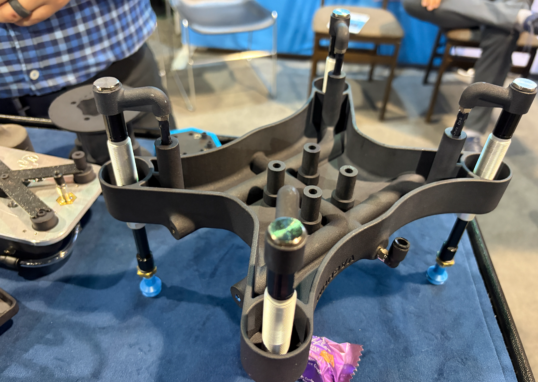
Additive Manufacturing at Scale: 3D Printing the 2026 Economy
- 0
- 173 words
After years of being a prototyping tool, 3D printing (Additive Manufacturing) has officially moved to mass production in 2026, with the global...
Read out all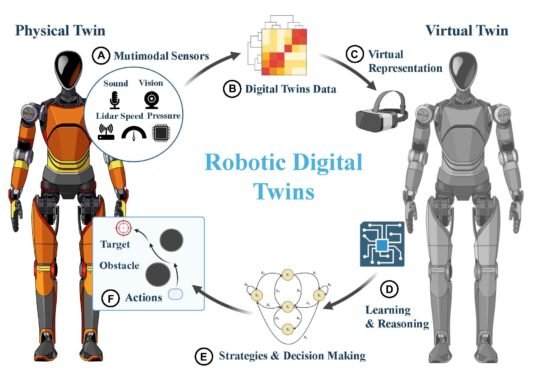
Digital Twin 2.0: From Simulation to Autonomous Decision-Making
- 0
- 181 words
Digital Twins in 2026 have reached “Level 3 Maturity.” They are no longer just 3D models; they are Live Biological Mirrors of...
Read out all