
- 0
- 188 words
In 2026, we are no longer sending all satellite data back to Earth for processing. Orbital Data Centers are the new “High Ground” for the global tech industry.
1. Reducing the “Data Bottleneck”
Satellites generate terabytes of high-resolution imagery and sensor data daily. In the past, downloading this data created massive delays. In 2026, companies like SpaceX and specialized startups use onboard AI processing. Instead of sending a massive image of a forest, the satellite only sends a 1KB alert: “Wildfire detected at coordinates X, Y.”
2. Space-Native LLMs
Small, specialized Large Language Models (LLMs) are now being trained directly on satellites. These “Edge Models” are hardened against cosmic radiation and optimized to run on the limited power of solar arrays. They allow satellites to autonomously re-task themselves based on what they “see” on the ground without waiting for instructions from a ground station.
3. Mesh Communication
Using Inter-Satellite Links (ISL) and laser communication, 2026 constellations act as a decentralized supercomputer in space. If one satellite lacks the processing power to analyze a complex storm pattern, it “hands off” the task to a nearby satellite in the mesh, distributing the workload across the orbit.
Author

hq2026host4@gmail.com
Related Posts

The Sovereign AI Trend: Why Nations are Building Their Own LLMs
- 0
- 194 words
By April 2026, the era of relying solely on “Big Tech” for AI is ending. Countries like the Kyrgyz Republic, Saudi Arabia,...
Read out all
6G and the “Internet of Senses”: What to Expect by 2028
- 0
- 167 words
While we are in the peak of the 5G era in 2026, the 6G prototypes being tested today in China and the...
Read out all
The AI Agentic Mesh: How Autonomous Agents Coordinate the 2026 Smart Factory
- 0
- 203 words
In 2024, AI was a tool we used. In 2026, AI is a workforce. The “Agentic Mesh” is a decentralized network of...
Read out all
Human-Cobot Collaboration: The Symbiotic Rise of 2026
- 0
- 169 words
By April 2026, Collaborative Robots (Cobots) have moved beyond simple “pick and place” tasks. They are now industrial-grade partners capable of precision...
Read out all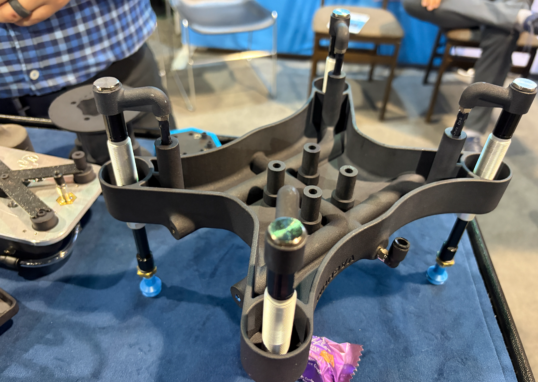
Additive Manufacturing at Scale: 3D Printing the 2026 Economy
- 0
- 173 words
After years of being a prototyping tool, 3D printing (Additive Manufacturing) has officially moved to mass production in 2026, with the global...
Read out all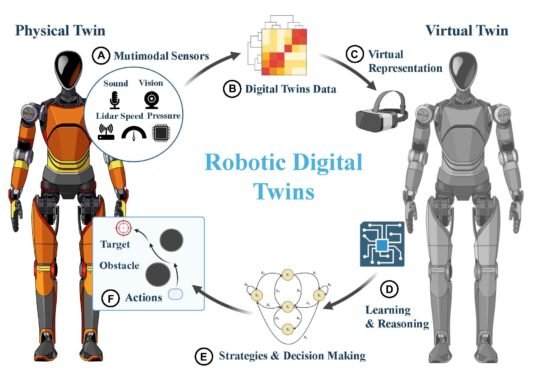
Digital Twin 2.0: From Simulation to Autonomous Decision-Making
- 0
- 181 words
Digital Twins in 2026 have reached “Level 3 Maturity.” They are no longer just 3D models; they are Live Biological Mirrors of...
Read out all